Central Iowa remodeling guides
How to know if storm damage requires a full roof replacement
Storm damage roof replacement is needed at 30%+ slope damage or 8+ hail hits per test square. See the 2026 thresholds before you file an insurance claim.
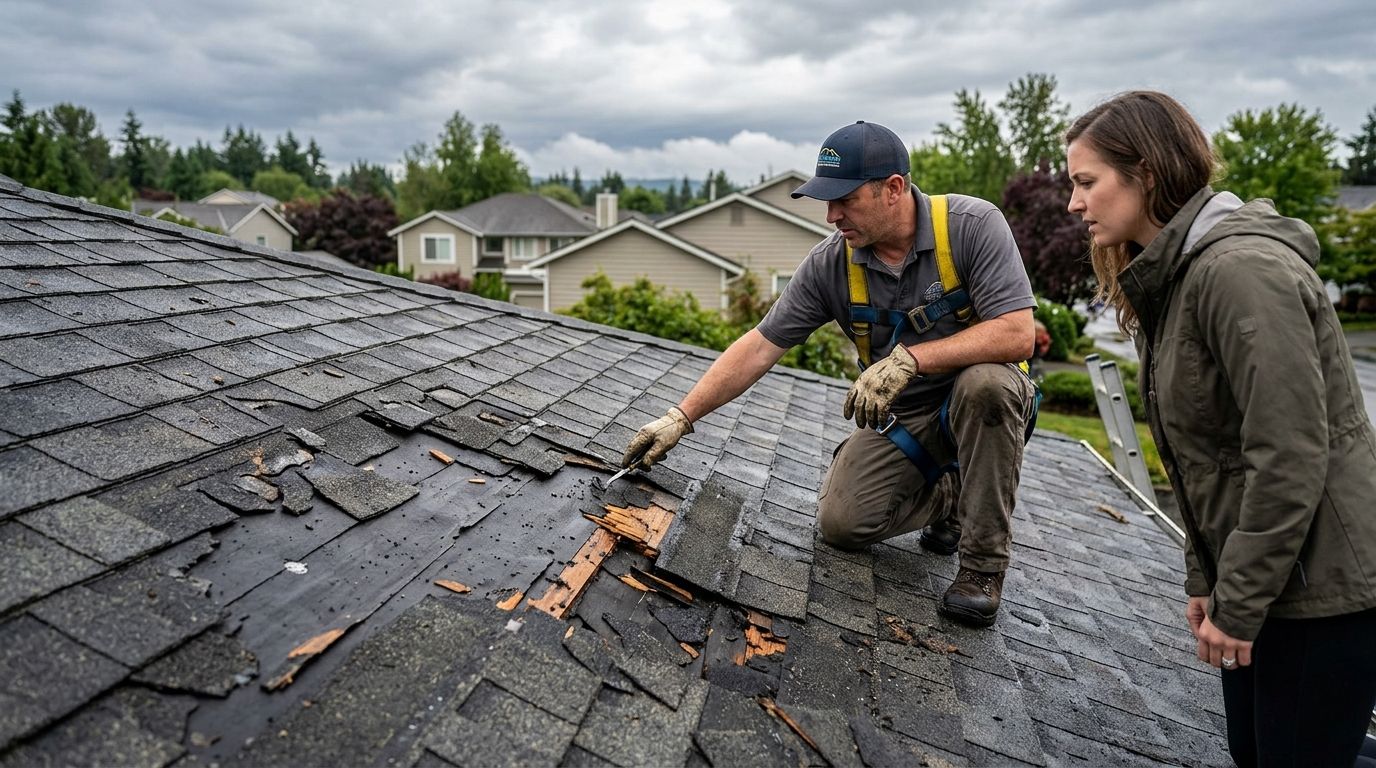
A roof needs full replacement after storm damage when more than 30% of a single slope shows granule loss or cracking, when hail testing finds 8 or more impact hits per 10-foot test square, or when wind has lifted shingles across multiple slopes rather than one isolated spot. A roof under 10 years old with scattered damage on one slope is usually a repair; a roof past 20 years with damage on two or more slopes almost always gets replaced, because most insurance carriers won't approve a partial tear-off on shingles that old. The cost most homeowners miss isn't the shingles — it's the decking underneath, which only gets inspected once tear-off begins.
- Storm damage roof replacement is the right call once damage covers 30%+ of a slope or spans multiple slopes, not one isolated spot.
- Hail damage gets scored with a 10-foot test square: 8 or more hits typically triggers a full-slope replacement in a 2026 claim inspection.
- Roofs past 20 years rarely get repair-only approval after a storm claim, because shingle color and wear cannot be matched.
- Wind damage on two or more slopes is a replacement roof; wind damage on one slope with sealed shingles below is often repairable.
- Phoenix Construction Solutions handles storm reconstruction across Central Iowa, including the adjuster walk-through.
Why this matters
Central Iowa takes hail and straight-line wind events every storm season, and the difference between a spot repair and a full tear-off comes down to documentation, not opinion. Insurance adjusters use specific measurable thresholds to approve or deny a claim, and homeowners who don't know those thresholds accept repair-only scopes on roofs that actually qualify for replacement.
Getting this wrong costs you twice. Once on a roof that fails again in the next storm, and again when the next claim gets denied because the carrier classifies the damage as pre-existing wear rather than a new storm event.
Phoenix Construction Solutions is a licensed and insured contractor based in Carlisle, Iowa, working with homeowners in Des Moines, Ankeny, Waukee, West Des Moines, Urbandale, Norwalk, and Pleasant Hill on storm reconstruction. The pattern repeats every season: roofs that look intact from the driveway fail the test-square check up close.
How to know if storm damage requires a full roof replacement
The decision comes down to four checks — coverage area, damage type, roof age, and decking condition. Here is how each one splits a repair from a replacement.
| Condition | Repair likely | Full replacement likely |
|---|---|---|
| Damage spread | One slope, isolated spots | Two or more slopes affected |
| Hail hits per 10-foot test square | Fewer than 8 | 8 or more |
| Shingle age | Under 10-12 years | Over 20 years |
| Decking condition | Dry and solid | Soft, delaminated, or water-stained |
| Granule loss | Minor and scattered | Heavy, fiberglass mat exposed |
| Shingle availability | Current product line | Discontinued color or profile |
If your roof lands in the right-hand column on two or more rows, full replacement is the honest recommendation — not a repair that buys one more season and then fails.
One caution on self-inspection: do not walk a storm-damaged roof. Hail-bruised shingles are structurally weakened, wet decking is unpredictable, and a fall from a residential roof is a worse outcome than any claim decision. Ground-level photos, attic inspection from inside, and a contractor who carries insurance are the safe path.
Wind damage: multiple slopes means replacement, not patching
Wind that lifts shingles on a single slope — typically the side facing the prevailing storm direction — can often be repaired when the shingles below remain sealed and the underlayment is intact. Creasing is the detail to look for. A shingle that folded back and laid down again looks fine from the ground but has a crack across the mat that will leak within a season or two.
Once uplift appears on two or more slopes, patching one section leaves the rest of the roof compromised and visibly mismatched. Wind damage on more than one slope is a full-replacement roof.
Hail damage: 8 or more hits per test square is the trigger
Roofing inspectors mark a 10-foot-by-10-foot test square on each slope and count impact marks inside it. This is the standard method both insurance adjusters and roofing contractors use to separate cosmetic hail marks from functional damage.
Eight or more hits in that square, combined with granule loss or exposed fiberglass mat, is the threshold most carriers apply to approve a full-slope tear-off in 2026 claims. Fewer hits with the mat still covered generally gets classified as cosmetic and does not qualify for replacement coverage at all.
Check the soft metal on the house too. Dented gutters, downspouts, furnace flashing, and vent caps confirm hail size and direction, and they help date the storm event when the adjuster arrives.
Roof age: 20+ year shingles rarely get repair approval
Asphalt shingles carry a service life of roughly 20 to 25 years in Iowa's freeze-thaw and summer-heat cycle. When storm damage hits a roof already near the end of that window, contractors and adjusters both default to full replacement, because sun-baked shingles crack during handling and discontinued color lines make matching impossible.
A 22-year-old roof with hail damage on even one slope is a replacement candidate almost every time in 2026.
Decking: the check that changes the scope mid-job
The shingles are the visible layer; the plywood or OSB decking beneath them is what determines whether a tear-off stays on budget. Water that entered through cracked shingles months earlier can delaminate decking without ever showing a ceiling stain. Signs from inside the attic: daylight at seams, dark staining on the underside of the sheathing, rusted nail points, or a spongy feel underfoot on the joists.
Ask every bidder whether decking replacement is included in the written scope or billed as a change order once the roof is open. That single line item is the most common source of surprise cost on storm work.
Get a storm damage roof inspection
Licensed and insured reconstruction serving Central Iowa homeowners.
Why the replacement decision varies house to house
The same hailstorm produces a repair on one house and a full tear-off next door. Six factors drive the difference:
- Roof age at the time of the storm — a 5-year-old roof absorbs impact differently than a 20-year-old roof with brittle shingles.
- Slope count and pitch — steep multi-slope roofs catch wind damage in more locations than a simple gable.
- Decking condition underneath — soft or rotted sheathing found during tear-off expands the scope even when the shingles looked serviceable.
- Carrier inspection standards — some insurance carriers apply stricter hit-count rules than others on hail claims.
- Local code requirements — a full tear-off can trigger current ventilation and ice-and-water shield requirements that a spot repair never touches.
- Material availability — a discontinued shingle line makes partial matching impossible and pushes the whole slope, or the whole roof, to replacement.
Will insurance pay for a full roof replacement after a storm?
Insurance pays for full replacement when the adjuster's inspection documents damage that meets the carrier's own hail-hit or wind-spread threshold — not because a homeowner requests it. The walk-through is where the claim is decided, which is why having a contractor on site to point out damage on the back slopes and the soft-metal evidence changes outcomes more than the initial filing does.
Document before anyone arrives: dated photos of the storm damage, photos of dented gutters and vents, the storm date, and any interior water evidence. Phoenix Construction Solutions walks Central Iowa homeowners through working with your insurance adjuster on a home reconstruction before the inspection happens rather than after the scope is written.
Can you repair just one slope after hail damage?
Yes — a single-slope repair holds up when hail hits stay under 8 per test square, the damage is confined to that slope, and the decking below is dry and solid. Once a second slope shows comparable damage, most contractors treat it as a full-roof scope, because shingles installed years apart weather differently and the color break is permanent.
One practical test: pull the manufacturer and color from the original permit or the leftover bundle in the garage. If that product is discontinued, the repair-only path is already closed.
How long do you have to file a storm damage claim?
Most policies set a filing window of one year or less from the date of the storm, though the exact deadline depends on carrier and policy language — read the loss-notification clause rather than assuming. Filing within weeks of the storm gives the strongest documentation, because every additional rain event after the damage makes it harder for an adjuster to attribute the condition to one storm.
Should you sign a contract before the claim is approved?
No. Sign a scope of work after the claim is approved and the adjuster's estimate is in hand, so the contract matches the covered scope. Storm season brings out-of-area crews with pressure tactics; verifying licensing and insurance takes ten minutes and prevents the most expensive mistake in the process — how to verify a contractor's license and insurance in Iowa covers exactly what to check.
Homeowners should also read reconstruction services for storm-damaged homes in Central Iowa before approving a scope. The roof is rarely the only system a serious storm touches — siding, windows, gutters, and interior drywall often belong in the same claim.
FAQ
How do you know if storm damage requires a full roof replacement?
Full replacement is the call when damage covers more than 30% of a slope, hail hits exceed 8 per 10-foot test square, or the roof is already past 20 years old. Isolated damage on a single younger slope is usually repairable.
What is a roof test square for hail damage?
A test square is a 10-foot-by-10-foot section inspectors mark on each slope to count hail impact marks. Eight or more hits inside that square is the standard threshold carriers use to approve a full-slope replacement.
Is wind damage or hail damage worse for a roof?
Hail damage is harder to catch because it shows as granule loss and bruising rather than missing shingles. Wind damage is more visible but easier to confine to one slope when it hasn't spread.
Will insurance cover a full roof replacement after hail in 2026?
Insurance covers full replacement when the adjuster documents damage meeting the carrier's hit-count or spread threshold. Having a contractor present during the inspection improves the accuracy of that documentation.
How old does a roof have to be before insurers require full replacement?
Roofs past 20 to 25 years of service life rarely get repair-only approval because shingle matching is no longer possible. Younger roofs with isolated damage are far more likely to qualify for a partial repair.
Can a roof be repaired instead of replaced after storm damage?
Yes, when damage stays on one slope, hail hits are under 8 per test square, and the decking underneath is solid. Multi-slope damage or soft decking pushes the job to full replacement.
How soon after a storm should a roof be inspected?
Within days to a few weeks, before additional rain worsens exposed areas and blurs the timeline. Most policies also set filing deadlines that reward early documentation.
Who inspects storm-damaged roofs in Central Iowa?
Phoenix Construction Solutions is a licensed and insured reconstruction contractor based in Carlisle serving Des Moines, Ankeny, Waukee, West Des Moines, Urbandale, Norwalk, and Pleasant Hill. Call (515) 505-8781 to schedule an inspection.
One last thing
The detail that decides most 2026 storm claims isn't on the roof at all — it's the soft metal around it. Adjusters read dents in gutters, downspouts, and furnace flashing as physical proof of hail size and impact direction, and that evidence survives long after wind-driven rain has washed loose granules off the shingles. Photograph the metal the day you photograph the roof.