Central Iowa remodeling guides
How to compare bids from Central Iowa remodeling contractors
Compare contractor bids remodeling the right way in 2026: match scope, verify license and insurance, and read every line item before ranking by price.
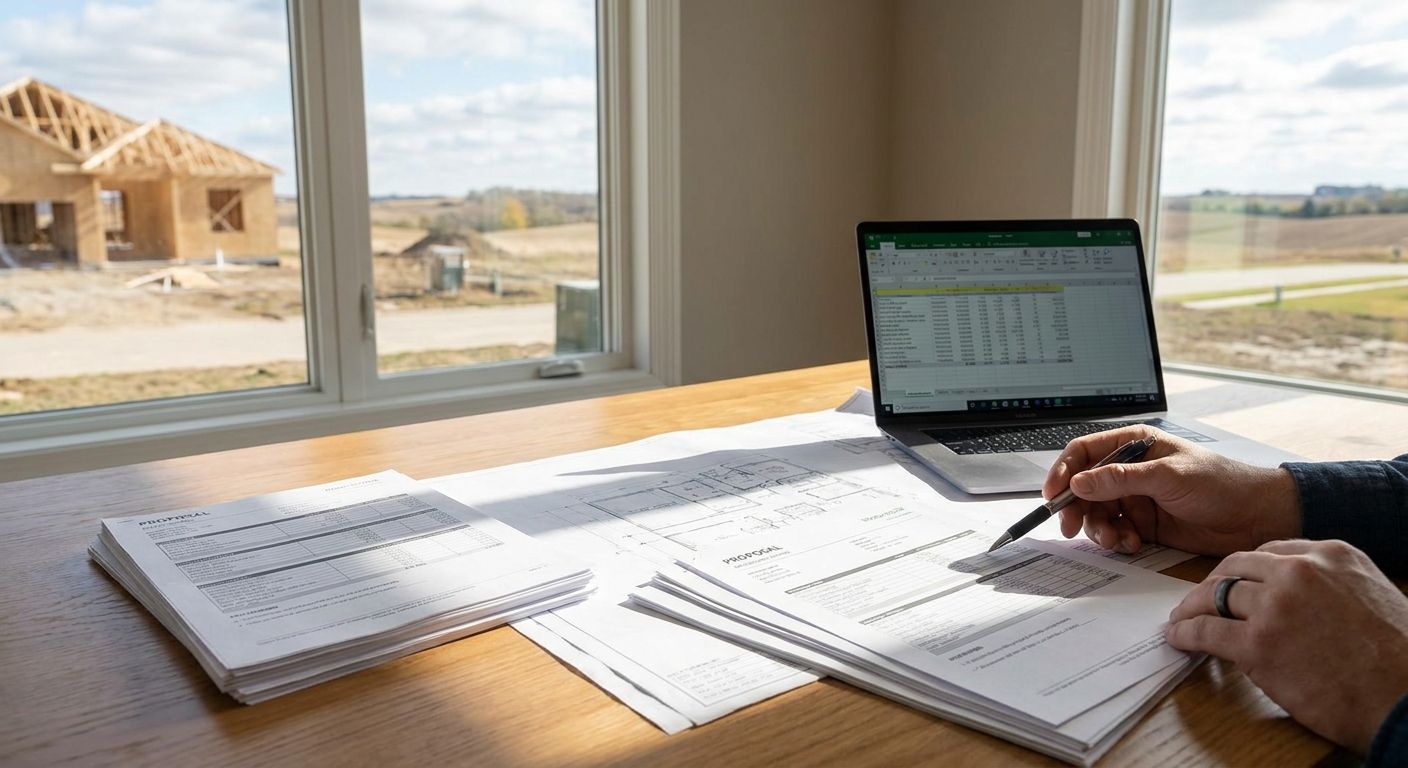
Comparing bids from Central Iowa remodeling contractors comes down to matching scope, not chasing the lowest number on the page. Line up at least three written bids for the identical project, verify license and insurance on each contractor, and compare line-item pricing before you ever look at the bottom-line total.
- Compare contractor bids remodeling by matching scope first — get three bids for the exact same project, not three different proposals.
- Verify license and insurance on every bidder before ranking price; Iowa has no statewide GC license, so proof comes straight from the contractor.
- Fixed-price bids protect your budget. Cost-plus and time-and-materials bids shift risk back onto you.
- Phoenix Construction Solutions writes itemized bids for Des Moines, Ankeny, Waukee, and the rest of Central Iowa.
- The lowest bid is usually the highest-risk bid when it skips permits, disposal fees, or subcontractor markup.
Why this matters
Most homeowners rank bids by total price and stop there. That's how a $28,000 kitchen bid loses to a $24,000 bid that quietly excludes plumbing rough-in, permit fees, or disposal — costs that show up as change orders once demo starts.
A remodeling bid is a legal proposal, not a quote for identical work. Two contractors can walk the same Waukee kitchen and hand you numbers $8,000 apart because one specified laminate countertops and the other quoted quartz, or because one carries full liability coverage and the other doesn't. Phoenix Construction Solutions works from written, itemized bids for exactly this reason — so homeowners in Des Moines, Norwalk, Pleasant Hill, Ankeny, Urbandale, and West Des Moines are comparing apples to apples, not guessing.
How to compare bids from Central Iowa remodeling contractors
Run every bid through the same checklist before you rank them by price. If a bidder can't answer a row below in writing, that's your answer on whether to move forward.
| Line Item | What to Check | Why It Matters |
|---|---|---|
| Scope of work | Same square footage, same rooms, same demo extent | Bids on different scope aren't comparable at all |
| Materials specified | Brand, grade, and model — not just "tile" or "cabinets" | A $5,000 swing in materials hides inside vague wording |
| Permits and fees | Named separately, not bundled into "labor" | City permit costs vary and get missed on lowball bids |
| Payment schedule | Draw amounts tied to completed milestones | Large upfront deposits are a red flag on any bid |
| Timeline | Start date and estimated completion window in writing | Vague timelines usually mean an overbooked crew |
| License and insurance | Current certificate of insurance, provided unprompted | Uninsured contractors leave you liable for job-site injuries |
| Change order policy | Written process for scope changes mid-project | No policy means every surprise becomes a dispute |
Verdict: the bid with the most detail wins, even if it isn't the cheapest. A three-line bid on a $30,000 basement remodel tells you almost nothing about what you're actually paying for.
The three bid types you'll see
Fixed-price bid: one number for the whole job
The contractor commits to a total price covering labor and materials as specified. Scope changes require a written change order, so your budget doesn't move unless you approve it. Best for: homeowners who want budget certainty on a defined project like a bathroom remodel or home addition. Verdict: Buy — this is the bid type to prioritize for most residential remodels in 2026.
Cost-plus bid: materials cost plus a contractor markup
You pay actual material and labor costs plus an agreed markup percentage. It works well when the scope isn't fully known upfront, like a fire-damaged rebuild or a reconstruction project tied to an insurance claim. Best for: reconstruction work with unknowns behind walls. Verdict: Hold — fine for damage repair, riskier for a straightforward kitchen or basement job where scope is already clear.
Time-and-materials bid: hourly labor plus receipts
You're billed for hours worked plus material costs as they're purchased, with no fixed ceiling. It's common for small repair jobs but a poor fit for a full remodel because there's no cap on your total exposure. Best for: small, hard-to-scope repairs only. Verdict: Skip for any project over a few thousand dollars — ask for a fixed-price bid instead.
Why contractor bids vary in Central Iowa
- Material grade and brand — laminate versus quartz, builder-grade versus name-brand cabinets, changes the number without changing the room
- City permit and inspection fees — Des Moines, Ankeny, and Waukee each set their own permit fee schedules, and a bid that omits them isn't a real comparison
- Home age and condition — older homes in Norwalk, Pleasant Hill, and Carlisle often need electrical or structural work a newer Urbandale build doesn't
- Subcontractor availability — plumbers and electricians booked out further in peak season push labor costs up on some bids more than others
- Project complexity — a basement finish with an egress window costs differently than a cosmetic refresh, even at similar square footage
- Insurance and bonding overhead — a fully licensed and insured contractor carries costs an uninsured operator simply doesn't, and that shows up in the bid
“The lowest bid is usually the bid missing the most line items, not the contractor with the best price.”
Before you sign anything, confirm the contractor's credentials directly — how to verify a contractor's license and insurance in Iowa walks through exactly what to ask for and how to check it. If you're still setting a number to bid against, how to budget for a whole-home renovation in Central Iowa covers what to set aside before bids even come in.
Get an itemized bid you can compare
Licensed and insured, serving Des Moines, Ankeny, and Central Iowa.
How many bids should I get before hiring a remodeling contractor?
Get at least three written bids before hiring a remodeling contractor for any project over a few thousand dollars. Two bids don't give you enough range to spot an outlier, and more than four usually just adds time without adding useful information for a homeowner comparing scope, not shopping for the absolute floor price.
What's a red flag in a remodeling bid?
A vague scope description is the biggest red flag in a remodeling bid — "remodel kitchen, $22,000" tells you nothing about materials, permits, or timeline. Other flags include a large upfront deposit before any work starts, no mention of insurance, and a total that's noticeably lower than every other bid with no explanation for the gap.
Should I always take the lowest bid?
No — the lowest bid is often the highest-risk bid, and taking it without checking scope invites change orders once work starts. Compare what's included line by line first; a mid-range bid with full scope, named materials, and proof of insurance usually costs less in the end than a low bid that grows once demo begins.
FAQ
How do I compare contractor bids for a remodeling project?
Compare contractor bids remodeling by matching scope, materials, and timeline line by line across at least three written bids before ranking by price. Confirm license and insurance separately from the bid itself.
How many bids should I get for a home remodel in Central Iowa?
Get at least three bids for any remodel over a few thousand dollars. Fewer than three doesn't show you the range, and it's the fastest way to catch a bid missing key line items.
Is a fixed-price bid better than a cost-plus bid?
A fixed-price bid is better for most residential remodels because it locks in a total and requires written change orders for scope shifts. Cost-plus bids make more sense for reconstruction work where the scope isn't fully known upfront.
What should be included in a remodeling contractor's bid?
A remodeling bid should include scope of work, named materials and brands, permit and fee costs, a payment schedule tied to milestones, a timeline, and proof of license and insurance. Missing any of these makes the bid hard to compare against others.
Why do remodeling bids vary so much between contractors?
Bids vary because of material grade, city-specific permit fees, home age and condition, subcontractor availability, and whether the contractor carries full insurance and bonding. Two bids on the same house can differ by thousands for these reasons alone.
Should I choose the contractor with the lowest bid?
No, the lowest bid often excludes line items like permits, disposal, or full material specs. Compare scope first, then price, so you're not choosing based on an incomplete number.
How do I verify a contractor is licensed and insured in Iowa?
Ask the contractor directly for a current certificate of insurance and proof of any local permits or registrations required for your city, since Iowa doesn't run a statewide general contractor license. Get it in writing before signing any bid.
What's a reasonable payment schedule for a remodeling bid?
A reasonable payment schedule ties draws to completed milestones rather than a large deposit upfront. If a bid asks for most of the total before work starts, treat it as a red flag.
One last thing
Ask every bidder for their certificate of insurance in writing before you compare a single price. It takes one email and eliminates unlicensed or underinsured contractors from the running before scope or cost even enters the conversation — and in Central Iowa, where remodeling demand keeps subcontractor schedules tight through 2026, that step alone filters out most of the bids you'd regret taking.