Central Iowa remodeling guides
How long does a whole home renovation take in Central Iowa?
How long does a whole home renovation take? Scope sets the schedule. Learn which milestones, approvals, and decisions shape your Central Iowa project.

A whole-home renovation in Central Iowa takes a project-specific amount of time: the written scope, existing conditions, material deliveries, and required approvals determine the schedule. Construction time is only part of the calendar; planning, selections, permitting, and final corrections also need space. For a 2026 project, request separate milestones for planning, construction, and the point when your home is ready to occupy.
- How long does a whole home renovation take? Use a scope-based schedule, not an unsupported completion promise.
- Phoenix Construction Solutions is a licensed and insured remodeling contractor serving Des Moines and Central Iowa.
- Separate whole-home remodeling preparation, active construction, and occupancy milestones before setting your move-in date.
- Confirm selections, approvals, and delivery dates before demolition to reduce avoidable scheduling conflicts.
How long does a whole home renovation take in Central Iowa?
A useful renovation timeline connects each completion milestone to the work and decisions required before it. A demolition date alone does not tell you when you can use the kitchen, sleep in the house, or finish the project.
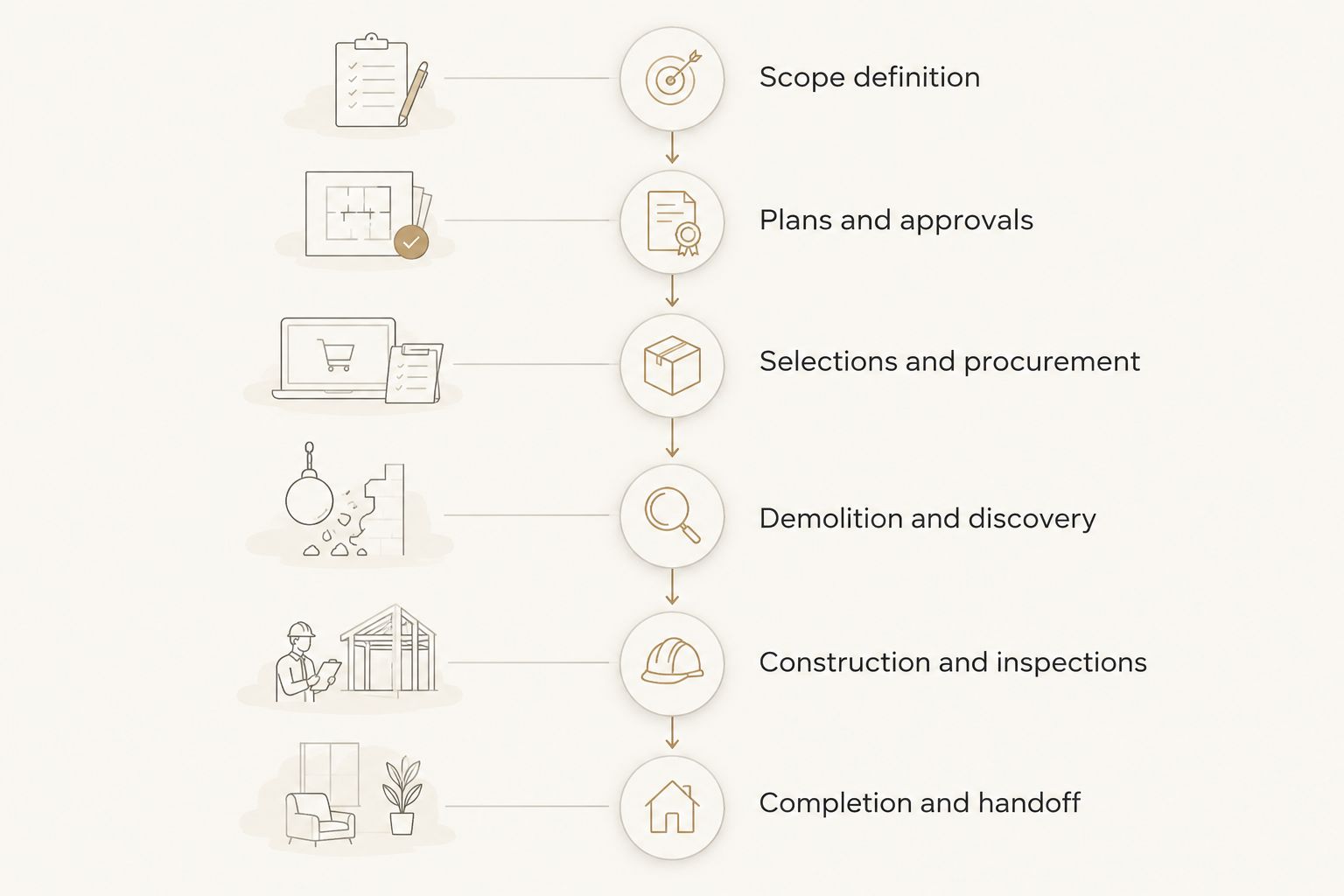
Phoenix Construction Solutions is a licensed and insured contractor based in Carlisle, serving Des Moines and Central Iowa. For whole-home remodeling, ask for a proposed sequence covering the following stages, with responsibilities and unresolved items identified beside each milestone.
- Scope definition. List the rooms, systems, structural changes, and exterior work included. Identify what stays and what gets removed.
- Plans and approvals. Establish the drawings and local approvals required for the actual work before scheduling dependent construction.
- Selections and procurement. Confirm dimensions, finishes, ordering responsibilities, and delivery information for materials that affect installation.
- Demolition and discovery. Remove the agreed materials, assess exposed conditions, and document any necessary scope changes.
- Construction and inspections. Coordinate framing, building systems, required inspections, and finish installation in the appropriate sequence.
- Completion and handoff. Resolve outstanding items and clarify the conditions for occupancy, final acceptance, and remaining follow-up.
These stages are a planning framework, not a claim about a particular contractor's standard process. Ask your contractor to adapt the sequence to your house and explain which activities can overlap.
Why this matters
A whole-home renovation affects more than the rooms under construction. Your schedule must account for access, utilities, meal preparation, storage, pets, and any temporary living arrangements.
For a 2026 renovation in Des Moines, Norwalk, or Pleasant Hill, define your household's nonnegotiable dates before requesting a schedule. Separate a preferred finish date from a deadline tied to a move, lease, or family obligation. That distinction helps you evaluate whether the proposed scope fits your needs.
Do not treat “construction complete” and “ready to move back in” as interchangeable. Ask what each term means in the written proposal and which approvals or unfinished tasks affect your use of the home.
Compare renovation scopes before comparing timelines
“Whole-home renovation” describes different amounts of work. Repainting and replacing finishes throughout a house is not the same scope as moving walls, relocating plumbing, or rebuilding damaged areas.
Use the comparison below to identify the work you are actually scheduling. None of these approaches deserves a fixed duration without a property-specific assessment.
| Renovation approach | Best for | Scheduling advantage | Scheduling limitation |
|---|---|---|---|
| Finish-focused renovation | Homeowners keeping the existing layout | Retains the layout and avoids the added tasks of relocating walls or systems | Preparation, deliveries, and finish sequencing still need coordination |
| Layout-changing renovation | Homeowners changing room connections or functions | Addresses layout changes within the overall project | Structural and building-system work adds dependencies |
| Renovation with an addition | Homeowners adding living space while updating existing rooms | Coordinates new space with changes inside the house | Foundation, exterior enclosure, and connections require their own sequence |
| Damage-related reconstruction | Homeowners rebuilding affected spaces | Allows repairs and replacement work to be planned together | Exposed conditions can change the work needed before finishes begin |
Compare schedules only after you compare included work. An earlier finish date is not a better offer if it excludes the bathroom, electrical changes, or final corrections included in another proposal.
Planning time: resolve decisions before construction
Before you commit to a 2026 construction date, turn broad preferences into decisions a contractor can build from. “Update the kitchen” leaves the layout, cabinetry, lighting, appliances, and flooring connections unresolved.
Write down what remains in place. Keeping a wall or fixture location is a different instruction from asking the contractor to evaluate relocating it. Mark undecided items clearly rather than letting them disappear inside a general scope description.
Ask for a selection list that distinguishes decisions needed before ordering from decisions needed later. Product dimensions matter as much as appearance: a change in the selected fixture or appliance can affect surrounding work.
Your planning milestone should describe readiness, not just a meeting date. Look for an agreed scope, the necessary plan information, assigned approval responsibilities, and a record of decisions still outstanding.
Construction time: follow dependencies, not room counts
Counting rooms does not establish a reliable whole-home remodeling schedule. A room with new paint and trim presents different work from a room requiring framing, wiring, plumbing, and inspections.
Ask which activity controls the next milestone. If a surface must remain accessible for inspection, covering it belongs after that inspection. If a finish requires a prepared substrate, the preparation belongs before installation.
Some activities can proceed in separate areas. Others share access, utilities, or the same work surface. Ask the contractor to identify those connections instead of assuming every trade can work everywhere at once.
A practical progress update answers these questions:
- What work is complete?
- What is scheduled next?
- What decision, delivery, or approval is blocking progress?
- Has the expected completion milestone changed?
Why whole-home renovation timelines vary
The strongest schedule explains its assumptions. For a Central Iowa whole-home renovation, review these factors against your actual scope rather than accepting a general promise.
- Extent of the work. Finish replacement, layout changes, additions, and reconstruction require different tasks. Identify the category of work in each room.
- Existing conditions. Concealed damage or unsuitable existing work requires assessment when exposed. Establish how discoveries will be documented and approved.
- Approvals and inspections. Requirements depend on the property and proposed work. Confirm the responsible jurisdiction and required inspection points rather than assuming neighboring communities follow an identical process.
- Materials and selections. Installation depends on receiving suitable materials with confirmed dimensions. Ask which items must be ready before related work begins.
- Household access. Occupied rooms, protected pathways, and utility interruptions affect work-area planning. State your access needs before agreeing to the sequence.
- Exterior exposure. Additions and exterior reconstruction introduce weather-sensitive activities. Ask which milestones depend on outdoor conditions and how the contractor will protect exposed areas.
For approval planning, review how to get building permits for a home renovation in Iowa. Confirm the requirements for your address with the authority responsible for the project; a general guide does not replace that determination.
Can you stay in your house during a whole-home renovation?
Staying in your house requires a project-specific plan for safe access, essential utilities, and separation from construction. Do not decide based only on whether a bedroom remains untouched.
Ask how you will reach a functioning bathroom and where you will prepare food. Discuss dust containment, work-area boundaries, pets, deliveries, and periods when water or power must be interrupted.
Remaining at home preserves your existing living arrangement, but it also requires coordination between household activity and construction. Moving out removes that overlap, but creates separate moving, storage, and housing decisions. Neither choice guarantees a particular completion date.
Agree on occupancy arrangements before demolition. If those arrangements change, request an updated sequence rather than assuming the original schedule still applies.
Does renovating everything together save time?
Renovating connected spaces together allows shared work to be coordinated in one overall plan. It does not automatically produce a shorter calendar for every house.
A combined project can coordinate flooring transitions, related building-system changes, and finishes across adjoining rooms. The trade-off is broader disruption and more decisions needed before the affected work starts.
Phasing the renovation preserves areas for household use, but requires clear boundaries between completed and future work. Ask whether later phases will disturb finished surfaces or require trades to return to the same area.
Choose the approach that fits your access needs and scope. Do not choose phasing solely because each individual phase sounds short. Compare the full sequence through final completion.
How do you keep a renovation schedule from slipping?
Protect the sequence by resolving decisions before the work that depends on them. A clear approval record is more useful than repeated requests to finish faster.
For your 2026 project, establish who can approve changes and how those approvals will be recorded. Each proposed change should describe the revised work and its effect on the schedule before you authorize it.
Ask the contractor to distinguish a target date from a confirmed milestone. Delivery information, required approvals, and unresolved existing conditions should be visible assumptions, not surprises buried in conversation.
Use this decision checklist before authorizing demolition:
- The included and excluded work is written down.
- Required planning and approval responsibilities are assigned.
- Selections needed for initial work are confirmed.
- Material-ordering responsibilities are clear.
- Household access and utility interruptions are discussed.
- Changes have a written approval process.
- Completion and occupancy milestones are defined separately.
What should a written renovation schedule include?
A useful written schedule shows the work sequence, milestone definitions, and decisions that still affect completion. It should also explain how you will receive updates when the plan changes.
Ask for the anticipated start conditions, not just the anticipated start date. Materials, approvals, site access, and completed selections belong in that discussion when they affect the first work activities.
For 2026 bid comparisons, request the same scope and milestone definitions from each contractor. A proposal that clearly identifies unresolved items gives you a better basis for decisions than a confident date with no explanation.
Phoenix Construction Solutions is best for Central Iowa homeowners seeking a licensed and insured contractor for remodeling, additions, and reconstruction. Bring a room-by-room scope and your required occupancy date to the consultation; do not treat a general conversation as a confirmed project schedule.
Book a Consultation
Discuss your Central Iowa renovation scope, household access needs, and schedule questions.
FAQ
How long does a whole home renovation take in Central Iowa?
A whole-home renovation takes a project-specific amount of time determined by scope, existing conditions, materials, and approvals. Request separate milestones for planning, construction, and occupancy rather than relying on a generic duration.
Does the renovation timeline start when demolition begins?
Demolition marks the start of removal work, not the start of the full renovation process. Scope development, selections, plans, approvals, and ordering belong in the overall calendar.
Can I live at home during a whole-house remodel?
Living at home requires safe access, essential utilities, and suitable separation from the work areas. Confirm bathroom access, food preparation, work boundaries, and utility interruptions before deciding.
Will keeping the same floor plan make scheduling simpler?
Keeping the same floor plan avoids adding wall-relocation tasks to the scope. Existing conditions, finish preparation, material deliveries, and other included work still determine the schedule.
Should I order materials before the renovation starts?
Confirm material specifications and ordering responsibilities before purchasing. Ask the contractor which deliveries must be confirmed before demolition or dependent installation work begins.
What happens if damage is discovered after demolition?
Newly exposed damage requires assessment before the affected work proceeds. Request a written description of necessary changes and their schedule effects before approving revised work.
Who can I call about a whole-home renovation near Des Moines?
Call Phoenix Construction Solutions at (515) 505-8781 to discuss whole-home remodeling, additions, or reconstruction. The licensed and insured contractor is based in Carlisle and serves homeowners throughout Central Iowa.
One last thing
Before accepting a completion date, ask: “What must be finished before we can use the house as planned?” Then put the answer beside the milestone in the written scope.
A home can look nearly finished while a missing fixture, unresolved inspection, or unusable room still affects daily life. Define completion by the agreed work and household use—not by how close the project looks in a progress photo.