Central Iowa remodeling guides
Best materials for rebuilding a fire damaged home
Best fire damage rebuild materials for 2026: Type X gypsum, FRT lumber, mineral wool, and more ranked for Central Iowa fire damage rebuilds.
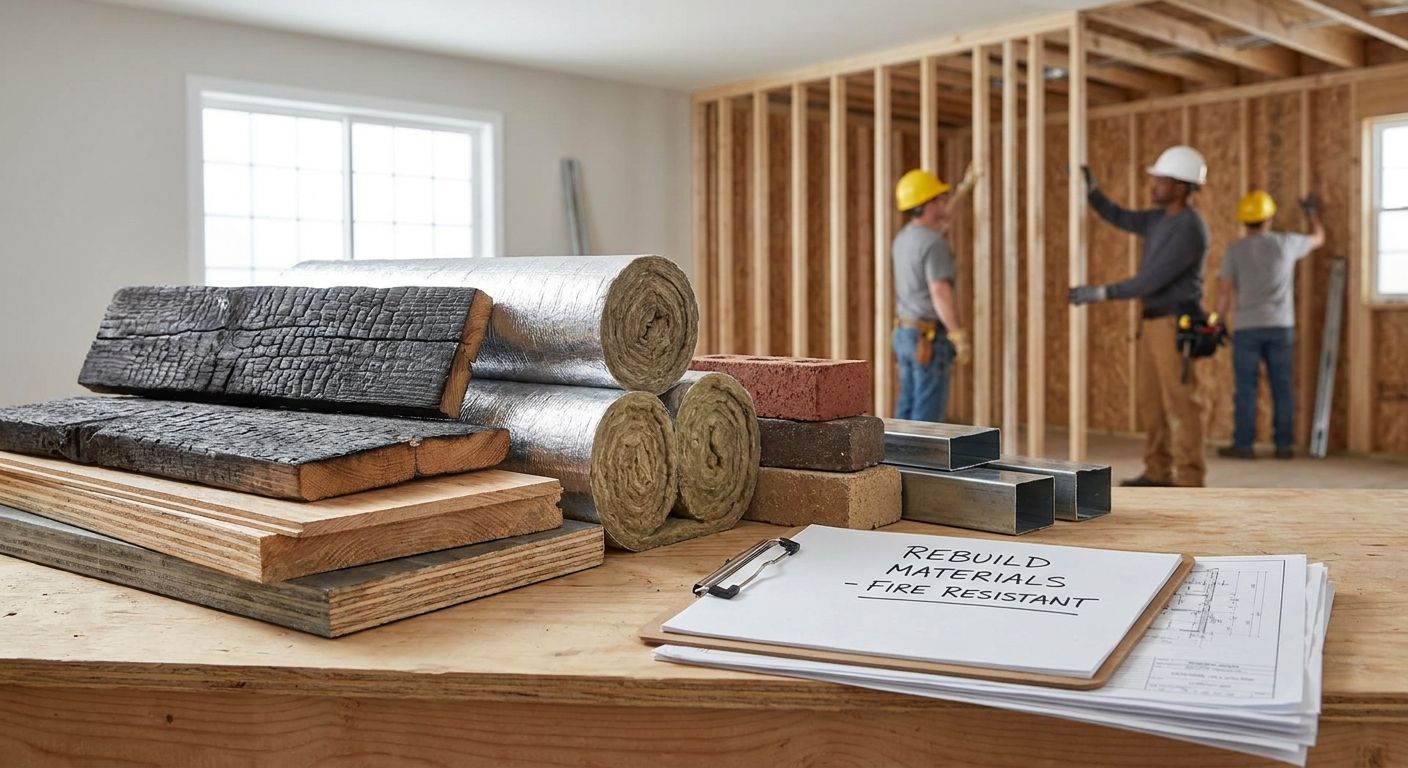
Rebuilding a fire-damaged home in Central Iowa comes down to one question after the insurance check clears: which materials actually stop the next fire from doing this much damage again? This guide ranks the six material categories that matter most for a fire damage rebuild in 2026, from framing to insulation to siding.
Best overall: Type X gypsum board. Best for structural framing: fire-retardant treated (FRT) lumber. Best for non-combustible framing: steel studs. Best for exterior cladding: fiber cement siding. Best for insulation: mineral wool. Best for foundation and structural rebuild: poured concrete and CMU block.
- Type X gypsum board is the best overall fire damage rebuild material for walls and ceilings in 2026.
- Fire-retardant treated lumber wins for structural framing; steel studs win where full non-combustibility matters.
- Fiber cement siding is the strongest exterior pick against future fire exposure and Iowa weather.
- Mineral wool insulation outperforms fiberglass on fire resistance in a fire damage rebuild.
- Poured concrete and CMU carry a fire damage rebuild's foundation and structural repairs without added fire risk.
Why this matters
A fire damage rebuild isn't a cosmetic remodel. Insurance adjusters, local code inspectors, and your own future risk tolerance all weigh in on what goes back into the walls. Get the material selection wrong and you've rebuilt a house that's exactly as vulnerable as the one that burned.
Phoenix Construction Solutions handles storm and fire damage reconstruction services for homeowners across Des Moines, Ankeny, Waukee, Urbandale, Norwalk, Pleasant Hill, and West Des Moines, and the material choices below reflect what actually gets specified on those jobs in 2026 — not a generic national list.
The cost of getting this wrong isn't abstract. Smoke and heat damage compromise standard materials in ways that aren't visible until months later, when moisture trapped behind untreated framing starts causing rot or mold.
What makes the best fire damage rebuild materials
- Fire rating — how many hours the assembly resists fire per UL design listings, not marketing claims
- Combustibility — whether the material itself burns or just resists heat transfer
- Code compliance — meets International Residential Code requirements as adopted locally in Iowa
- Moisture and mold resistance — critical after fire suppression water soaks framing and drywall
- Local availability — Central Iowa suppliers stock it without weeks of special-order delay
- Freeze-thaw durability — Iowa winters punish any material that can't handle repeated moisture cycling
Fire damage rebuild materials at a glance
| Material | Best for | Standout feature | Key limitation |
|---|---|---|---|
| Type X gypsum board | Walls and ceilings | 1-hour fire rating per 5/8-inch layer | Heavier, needs proper fastener spacing |
| FRT lumber | Structural framing | Treated to slow ignition without steel cost | Costs more than standard dimensional lumber |
| Steel studs | Non-combustible framing | Won't burn, warp, or feed a fire | Requires different fastening skills, higher labor time |
| Fiber cement siding | Exterior cladding | Non-combustible, resists embers | Heavier install, needs proper flashing detail |
| Mineral wool insulation | Wall and attic insulation | Melts at roughly 1,832°F, won't feed flame | Costs more per square foot than fiberglass |
| Poured concrete / CMU | Foundation and structural rebuild | Fully non-combustible, load-bearing | Not practical for interior partition walls |
1. Type X gypsum board: best overall for fire-rated walls and ceilings
Type X gypsum board is the standard fire-rated drywall used in nearly every code-compliant rebuild in 2026. The 5/8-inch panels contain glass fibers that slow heat transfer through the board core, giving a single layer a 1-hour fire rating in tested UL assemblies.
Type X gypsum board pros:
- Delivers a documented fire rating without exotic materials
- Widely stocked at Central Iowa lumber yards, no special order
- Installs with standard drywall tools and crews
- Doubles as sound dampening between rooms
Type X gypsum board cons:
- Heavier than standard 1/2-inch board, slows install slightly
- Fire rating depends on correct fastener pattern and taping — sloppy install voids the rating
Best for: any wall or ceiling assembly separating living space from a garage, mechanical room, or shared wall. Verdict: Buy.
2. Fire-retardant treated lumber: best for structural framing
Fire-retardant treated (FRT) lumber goes through a pressure-impregnation process that slows how fast wood ignites and spreads flame, without switching the whole frame to steel. It's a middle-ground pick for rebuilds where full steel framing isn't in the budget or the design.
FRT lumber pros:
- Slows ignition compared to untreated framing lumber
- Works with standard framing techniques and connectors
- Meets code requirements for fire-rated wall assemblies in many jurisdictions
FRT lumber cons:
- Costs noticeably more than standard dimensional lumber
- Some treatments can affect fastener corrosion over time — check compatible hardware
Best for: homeowners rebuilding the structural frame who want fire resistance without a full switch to steel. Verdict: Buy.
3. Steel studs: best for non-combustible framing
Steel studs remove the combustible material from the equation entirely. In a fire damage rebuild where the original frame burned through, some homeowners choose steel for the sections most exposed to future risk — garages, mechanical closets, shared walls.
Steel stud pros:
- Doesn't burn, warp from heat, or feed a fire
- Consistent, straight studs with no lumber warping over time
- Resists insect damage and won't rot from moisture
Steel stud cons:
- Requires crews experienced with metal framing — not every framing crew runs steel daily
- Higher material and labor cost than wood framing in most Central Iowa markets
Best for: garages, mechanical rooms, and shared walls where non-combustibility outweighs framing cost. Verdict: Hold — worth it for high-risk zones, overkill for the whole house.
4. Fiber cement siding: best for exterior fire resistance
Fiber cement siding is a cement-and-cellulose composite that doesn't ignite from embers the way vinyl or wood siding can. For an exterior rebuild after fire damage, it's the material most commonly specified where wildfire or ember exposure is a repeat concern.
Fiber cement siding pros:
- Non-combustible exterior cladding, resists ember ignition
- Holds paint longer than wood siding, handles Iowa's freeze-thaw cycles
- Doesn't warp, rot, or attract insects
Fiber cement siding cons:
- Heavier than vinyl, needs correct flashing and fastening detail
- Cutting generates silica dust — requires proper safety equipment on site
Best for: full exterior rebuilds where fire resistance and long-term durability both matter. Verdict: Buy.
5. Mineral wool insulation: best for fire-resistant insulation
Mineral wool (also called rock wool) insulation is made from spun basalt rock and slag, and it doesn't ignite or feed a fire the way some foam insulation products can. It melts at roughly 1,832°F rather than burning, and holds an R-value around R-4.2 per inch — competitive with or better than standard fiberglass batts.
Mineral wool pros:
- Won't feed a fire; melts rather than burning
- Higher R-value per inch than standard fiberglass batts
- Resists moisture and doesn't sag over time
Mineral wool cons:
- Costs more per square foot than fiberglass
- Denser material, slightly harder to cut and fit around wiring and plumbing
Best for: wall cavities and attic spaces in any fire damage rebuild where fire resistance matters as much as thermal performance. Verdict: Buy.
6. Poured concrete and CMU: best for foundation and structural rebuild
When a fire compromises a foundation or load-bearing structure, poured concrete and concrete masonry unit (CMU) block are the only realistic non-combustible options for that part of the rebuild. Neither burns, and both handle Iowa's freeze-thaw cycles when properly reinforced and drained.
Poured concrete / CMU pros:
- Fully non-combustible, carries structural loads
- Long service life when properly waterproofed
- Widely available from Central Iowa suppliers
Poured concrete / CMU cons:
- Not practical or cost-effective for interior partition walls
- Requires correct drainage and waterproofing detail to avoid moisture issues later
Best for: foundation repair or rebuild and any load-bearing structural element damaged by fire. Verdict: Buy.
“If the framing lumber isn't fire-retardant treated, you're rebuilding the same risk you just tore out.”
How we ranked these materials
Each material was weighed against the six criteria above: fire rating, combustibility, code compliance, moisture resistance, local availability, and freeze-thaw durability. Materials that failed on availability or added cost without a clear fire-resistance gain dropped to a narrower "best for" slot rather than a top overall spot.
Which fire damage rebuild materials should you choose?
For most Central Iowa fire damage rebuilds in 2026, Type X gypsum board paired with FRT lumber framing and mineral wool insulation covers the interior with a documented fire rating at a reasonable cost. Add fiber cement siding on the exterior and poured concrete or CMU wherever the foundation or load-bearing structure needs replacing.
Steel studs stay a targeted upgrade for garages and mechanical rooms rather than a whole-house standard — the cost premium doesn't pencil out everywhere.
Get a fire damage rebuild quote
Licensed and insured reconstruction for Central Iowa homeowners.
FAQ
What are the best fire damage rebuild materials in 2026?
Type X gypsum board, fire-retardant treated lumber, mineral wool insulation, and fiber cement siding form the core material list for a code-compliant fire damage rebuild in 2026. Steel studs and poured concrete cover the highest-risk framing and foundation sections.
Is FRT lumber worth the extra cost over standard framing lumber?
Yes, in most fire damage rebuilds it's worth it because it slows ignition without the labor and cost jump of full steel framing. It also satisfies fire-rated wall assembly requirements in many local codes.
Does Type X drywall actually stop a fire?
Type X gypsum board doesn't stop a fire outright, but a single 5/8-inch layer delivers a 1-hour fire rating in tested UL assemblies, buying critical time for evacuation and suppression.
Is mineral wool better than fiberglass for a fire damage rebuild?
Mineral wool outperforms standard fiberglass on fire resistance because it melts at roughly 1,832°F instead of burning, and it holds a slightly higher R-value per inch.
Should I use steel studs throughout a whole-house rebuild?
Not usually. Steel studs make sense for garages, mechanical rooms, and shared walls where non-combustibility matters most, but the added labor cost rarely justifies framing the entire house in steel.
What siding resists fire damage best?
Fiber cement siding is the strongest widely available option because it's non-combustible and resists ember ignition, unlike vinyl or untreated wood siding.
Can a damaged foundation be rebuilt with the original materials?
Poured concrete and CMU block are the standard non-combustible options for foundation and structural rebuilds, and they're the materials most fire damage reconstruction jobs return to regardless of what was originally used.
How do I know which materials my Central Iowa rebuild needs?
A licensed reconstruction contractor evaluates the extent of fire and water damage on site and specifies materials against local code requirements — a phone consultation is the fastest way to get a specific list for your property.
One last thing
Most homeowners rebuilding after a fire focus on the visible damage — charred framing, melted siding — and miss the water damage from suppression efforts that soaks into whatever's left standing. Mineral wool and Type X gypsum both hold up better against that trapped moisture than standard fiberglass batts and regular drywall, which is part of why they show up on so many 2026 rebuild specs even where a full fire rating isn't strictly required.