Central Iowa remodeling guides
Best flooring options for a whole home renovation in Central Iowa
Whole home flooring options ranked for 2026: LVP wins for wet-to-dry consistency, hardwood for resale, tile for bathrooms. Compare all six before you buy.
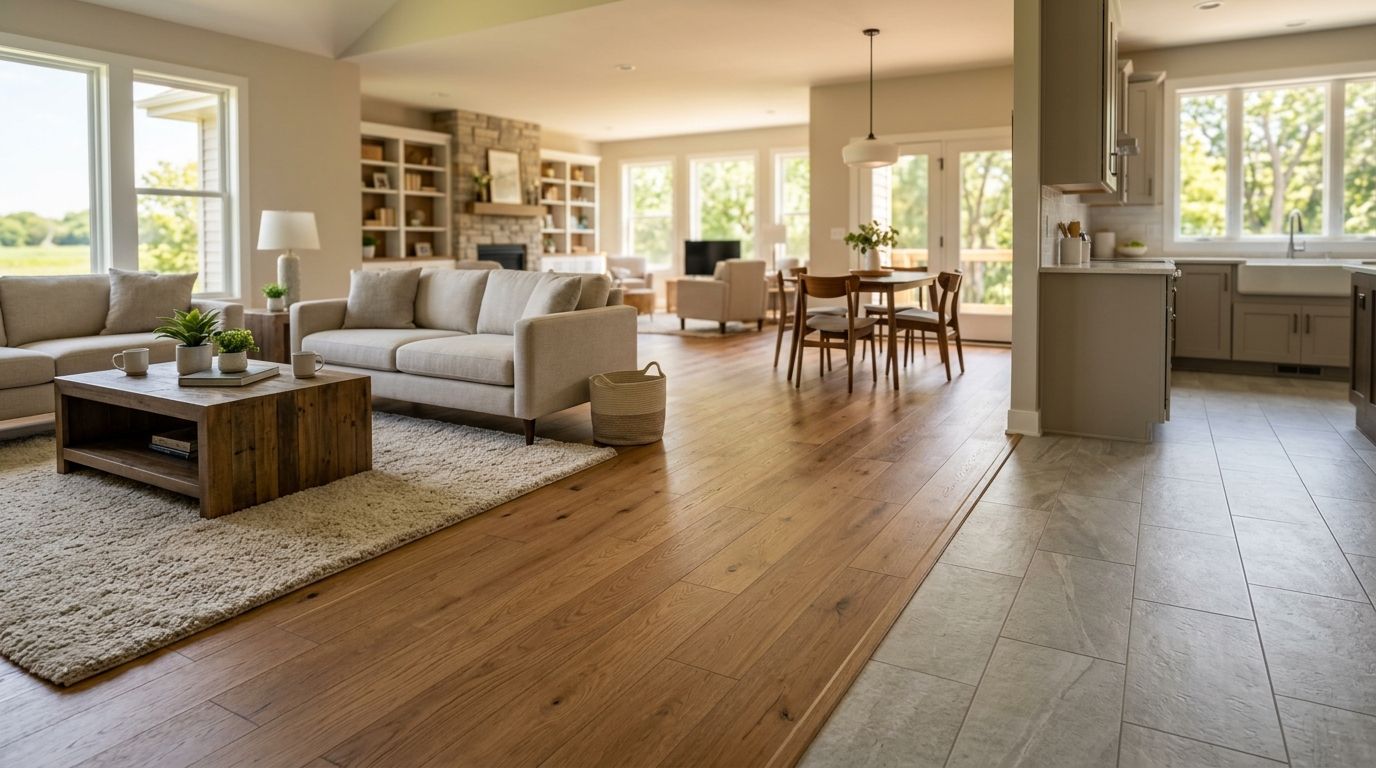
A whole-home renovation in Central Iowa means picking flooring for rooms that behave completely differently: a walkout basement that fights groundwater, a kitchen that sees spills daily, and bedrooms where comfort matters more than moisture resistance. The best whole home flooring options in 2026 aren't one material — they're a short list matched to each room's job.
- Luxury vinyl plank wins for whole home flooring options that need to survive kitchens, basements, and high-traffic hallways in Central Iowa.
- Engineered hardwood suits main living and dining areas where homeowners want real wood without solid hardwood's moisture risk below grade.
- Solid hardwood still commands the highest resale value but has no place in Central Iowa basements or bathrooms.
- Tile remains the only reliable answer for bathrooms and mudrooms that see standing water.
- Laminate is the budget call for a full-house 2026 renovation on a tight number.
Why this matters
Central Iowa runs through real winters and humid summers, and that swing moves wood, telegraphs subfloor imperfections, and punishes anything installed without a moisture plan. A whole-home job in Des Moines, Ankeny, Waukee, or West Des Moines usually touches four or five flooring zones at once — basement, kitchen, bathrooms, main living space, bedrooms — and each one has a different failure point.
Homeowners who pick one flooring type for the entire house usually regret it in the basement or the bathroom within a year or two. Phoenix Construction Solutions walks Central Iowa clients through material selection room by room as part of full remodels, not as an afterthought bolted onto the budget. If you haven't set numbers yet, the whole-home renovation budgeting guide is the place to start before you fall in love with a floor you can't afford to run through six rooms.
What makes the best whole-home flooring
- Moisture resistance — how the material handles basements, mudrooms, and bathroom splash zones
- Durability under daily traffic — hallways, kitchens, and entry points take the most abuse in any house
- Visual consistency room to room — whole-home jobs need a material that reads the same from the living room into the hallway
- Installation complexity — subfloor prep, moisture barriers, and whether it can go over radiant heat or concrete
- Comfort and sound — underfoot feel and noise transfer between floors
- Resale value — what a Central Iowa buyer expects to see when the house lists
Flooring options at a glance
| Flooring | Best for | Standout feature | Key limitation |
|---|---|---|---|
| Luxury vinyl plank (LVP) | Whole-house consistency in wet and dry zones | Waterproof core, works below grade | Can dent under heavy furniture without pads |
| Engineered hardwood | Main living and dining areas | Real wood veneer with better stability than solid | Limited number of refinishes over its life |
| Solid hardwood | Bedrooms and formal living spaces | Can be sanded and refinished multiple times | Not rated for basements or wet areas |
| Tile | Bathrooms and mudrooms | Fully water resistant, handles standing water | Cold and hard underfoot without in-floor heat |
| Carpet | Bedrooms and basement family rooms | Sound dampening and warmth | Traps moisture, poor fit for basements without a vapor barrier |
| Laminate | Budget whole-house renovations | Lowest material cost per square foot of the group | Core swells if water sits on seams |
1. Luxury vinyl plank: best whole-home flooring for wet-to-dry consistency
Luxury vinyl plank uses a waterproof core with a printed wood-look layer on top, and a wear layer that typically runs from 6 mil to 20 mil depending on the product line. It's the one material on this list rated to run continuously from a basement family room into a kitchen and down a hallway without a material change at the threshold.
LVP pros:
- Handles basements, bathrooms, and kitchens without a moisture barrier issue
- Consistent look installed across an entire whole-home renovation
- Click-lock installation goes down faster than nail-down wood
LVP cons:
- Can't be refinished — scratched planks get replaced, not sanded
- Lower-end products can look visibly synthetic up close
- Heavy furniture without protective pads can leave permanent dents
Verdict: Buy — the default pick for a Central Iowa whole-home project that needs one flooring strategy across multiple moisture zones.
2. Engineered hardwood: best flooring for main living and dining areas
Engineered hardwood layers a real wood veneer, often 2mm to 6mm thick, over a plywood or composite core that resists the expansion and contraction solid wood suffers through Iowa's seasonal humidity swings. It reads as authentic hardwood in the rooms where buyers and guests actually look closely.
Engineered hardwood pros:
- More dimensionally stable than solid hardwood through humidity changes
- Can go over radiant heat systems in some product lines
- Refinishable at least once, depending on veneer thickness
Engineered hardwood cons:
- Still not rated for basements or bathrooms
- Thinner veneers limit how many times it can be sanded
- Costs more per square foot than LVP in most product tiers
Verdict: Buy — pick this over solid hardwood for a Central Iowa main floor where stability matters as much as looks.
3. Solid hardwood: best flooring for bedrooms and resale value
Solid hardwood is a single piece of wood through and through — species like white oak (roughly 1,360 on the Janka hardness scale) and hard maple (around 1,450) are common choices for Central Iowa homes. It's the material buyers associate most with a finished, higher-end house.
Solid hardwood pros:
- Can be sanded and refinished multiple times over decades
- Carries the strongest resale association of any flooring on this list
- Wide range of species and stain options for exact color matching
Solid hardwood cons:
- Cannot go in basements, bathrooms, or below-grade spaces
- Moves with Central Iowa's humidity swings more than engineered wood
- Nail-down installation takes longer than click-lock products
Verdict: Buy for bedrooms and living rooms, Skip for basements and baths.
4. Tile: best flooring for bathrooms and mudrooms
Porcelain and ceramic tile are fully water resistant and hold up to standing water in a way no wood-look product does. In a whole-home renovation, tile isn't competing for every room — it's the mandatory answer for bathrooms, laundry rooms, and mudrooms.
Tile pros:
- Handles standing water and heavy scrubbing without damage
- Extremely long service life compared to wood-look products
- Wide range of sizes and patterns for bathroom and entry design
Tile cons:
- Cold and hard underfoot without in-floor heating installed
- Grout lines need periodic sealing and cleaning
- Heaviest installation, adding time and labor to a whole-home schedule
Verdict: Buy for bathrooms and mudrooms specifically — not a whole-house material.
5. Carpet: best flooring for bedrooms and basement family rooms
Carpet still wins on warmth and sound dampening, which matters in bedrooms and in basement rec rooms where hard floors echo. It's the softest option underfoot and the easiest on a budget compared to hardwood.
Carpet pros:
- Softest, warmest option for bedrooms and basement lounge spaces
- Dampens sound between floors better than any hard-surface material
- Wide range of pile and price points to match a whole-home budget
Carpet cons:
- Traps moisture and odor, a real risk in Central Iowa basements without proper vapor barriers
- Shows wear in high-traffic hallways faster than hard flooring
- Not suitable near kitchens or bathrooms
Verdict: Hold for bedrooms and basement rec rooms, Skip for main traffic paths and wet zones. If you're finishing a basement specifically, the basement flooring guide breaks down moisture barrier requirements in more depth.
6. Laminate: best flooring for a budget whole-house renovation
Laminate uses a photographic wood-look layer under a wear-resistant coating over a composite core. It's the lowest material cost per square foot among the wood-look options here, which matters when a whole-home job is stretching across six or more rooms.
Laminate pros:
- Lowest cost per square foot of the wood-look flooring options
- Scratch-resistant top layer holds up to pets and daily traffic
- Click-lock installation keeps labor time down
Laminate cons:
- Core swells if water sits on seams for any length of time
- Not a real fit for bathrooms or basements without a specific water-resistant core rating
- Can't be refinished once the surface wears through
Verdict: Buy for a tight whole-home budget, Skip for wet rooms.
How this list gets ranked
Each material is scored against the six criteria above — moisture resistance, durability, room-to-room consistency, install complexity, comfort, and resale value — with basement and bathroom performance weighted heavier, since those are the rooms where the wrong pick causes callbacks. No product here is ranked as a universal winner; the table exists so a homeowner can match material to room instead of picking one floor for a whole house.
Which whole-home flooring should you choose?
For most Central Iowa whole-home renovations in 2026, luxury vinyl plank across common areas, kitchens, and the basement, paired with tile in bathrooms and mudrooms, covers the moisture-heavy zones without a material change at every threshold. Engineered or solid hardwood in the main living space and bedrooms adds the resale polish LVP alone doesn't deliver. Carpet stays reserved for bedrooms and a basement lounge if sound dampening matters more than resale optics.
Plan your whole-home flooring layout
Licensed and insured remodeling across Central Iowa, room by room.
FAQ
What's the best whole home flooring option for Central Iowa?
Luxury vinyl plank is the best single option for whole-home consistency because its waterproof core handles basements, kitchens, and high-traffic hallways without a material change. Pair it with tile in bathrooms and mudrooms for the rooms that see standing water.
Is engineered hardwood better than solid hardwood for a whole-home renovation?
Engineered hardwood handles Central Iowa's humidity swings better than solid hardwood because its layered core resists expansion and contraction. Solid hardwood still wins on refinish life and resale perception, but neither belongs in a basement or bathroom.
Can you put hardwood flooring in a Central Iowa basement?
No, solid hardwood is not rated for basements or other below-grade spaces because ground moisture causes warping and cupping. Luxury vinyl plank or tile are the correct choices for basement flooring in 2026.
How much does whole-home flooring cost in Central Iowa?
Cost varies by material, square footage, and subfloor condition, so get a room-by-room quote rather than a single per-square-foot number. A licensed contractor can price LVP, hardwood, and tile separately across the same renovation.
Does carpet work in a Central Iowa basement?
Carpet in a basement needs a proper vapor barrier and moisture testing first, since Central Iowa basements are prone to trapped humidity. Without that barrier, carpet holds moisture and odor faster than any other flooring on this list.
What flooring holds up best in a mudroom?
Tile is the best mudroom flooring because it handles standing water, salt, and heavy scrubbing without damage. LVP is the second-best option where a continuous look from the kitchen into the mudroom matters more than tile's water ceiling.
Is laminate flooring worth it for a whole-home renovation?
Laminate is worth it when the renovation budget is tight and the rooms in question are dry — living rooms, bedrooms, and hallways. It's the wrong call for bathrooms, mudrooms, or basements where standing water is a risk.
One last thing
The flooring decision that actually saves a Central Iowa homeowner money isn't the material — it's sequencing. Flooring goes in after cabinets, trim, and paint in almost every whole-home job, and homeowners who install floors first end up paying to protect them through the rest of the renovation or replacing damaged sections before the house is even finished.