Central Iowa remodeling guides
Best decking materials for a Central Iowa deck addition
Best decking materials for a Central Iowa deck addition in 2026, ranked by freeze-thaw durability, upkeep, and cost — composite, pine, cedar, PVC, and hardwood compared.
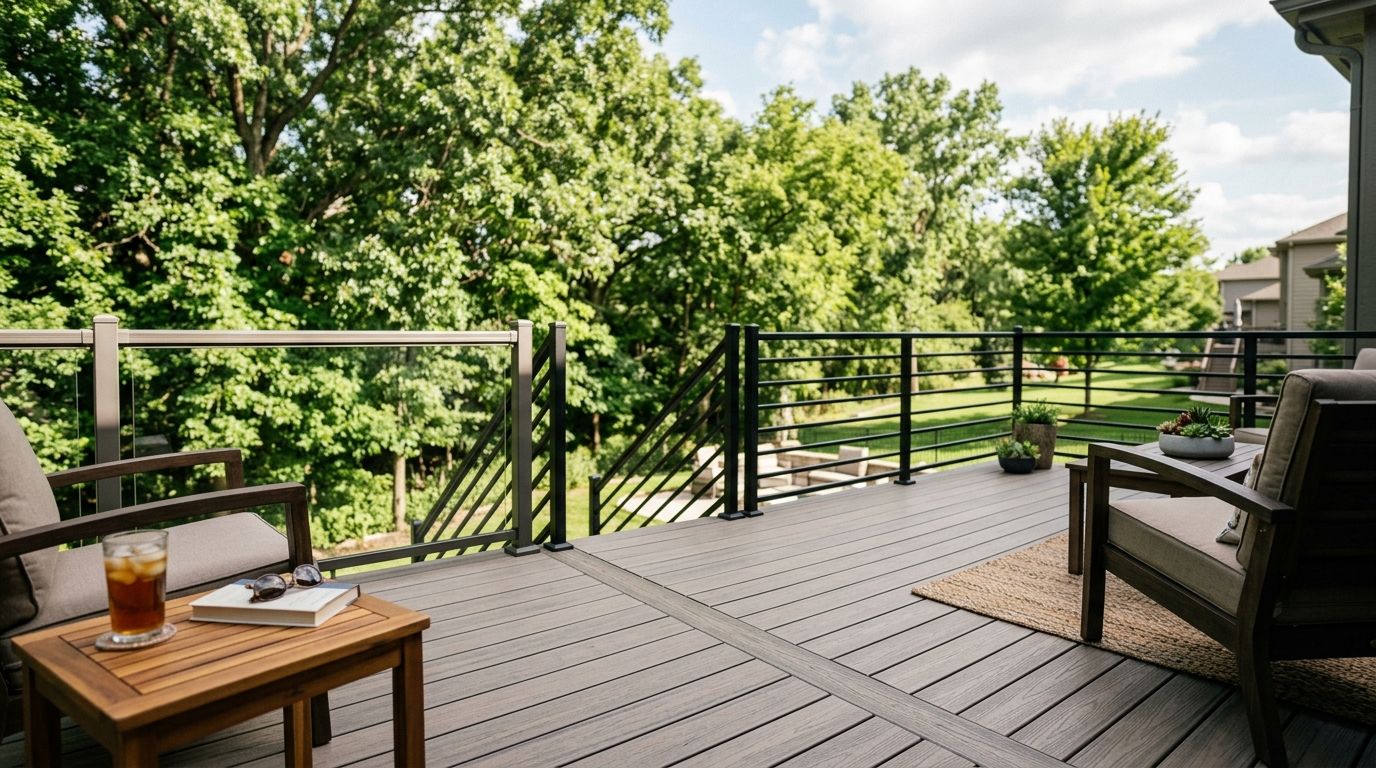
Choosing between decking materials before a deck addition in Central Iowa comes down to one question: which board survives repeated freeze-thaw cycles without cupping, splitting, or popping its fasteners. Best overall: composite decking. Best budget option: pressure-treated pine. Best for pool decks and low, wet areas: PVC decking. Best natural wood look: western red cedar. Best premium, long-span build: tropical hardwood. Iowa's climate swings from well below zero in January to the low 90s in July, and that range is what separates decking materials that hold up from ones that need replacing inside a decade.
- Composite decking is the best overall pick for a Central Iowa deck addition in 2026 — low upkeep and freeze-thaw stable.
- Pressure-treated pine is the best budget decking material but needs annual sealing to survive Iowa winters.
- PVC decking beats wood near pools and low-grade areas where moisture sits against the boards.
- Western red cedar gives the best natural wood look among decking materials but needs yearly staining here.
- Tropical hardwood spans farther with less framing but takes more skill to install correctly.
Why this matters
A deck addition is a structural project, not a cosmetic one — joists, ledger boards, and fasteners all have to handle snow load in winter and UV exposure in summer. Get the decking material wrong and you're looking at board replacement in five to seven years instead of fifteen or more. Phoenix Construction Solutions builds decks, patio structures, and full home additions across Des Moines, Ankeny, Waukee, West Des Moines, Urbandale, Norwalk, and Pleasant Hill, and the material call is usually the first decision a homeowner has to make before framing even starts.
Central Iowa's freeze-thaw cycle is the real filter here. Boards that expand and contract repeatedly through a typical winter will telegraph poor material choices fast — cupping, checking, and loose fastener heads show up within a season or two on the wrong product.
What makes the best decking material for a Central Iowa deck addition
- Freeze-thaw stability — resistance to cupping, splitting, and warping across repeated winter cycles
- Moisture resistance — how the board handles standing snowmelt and summer humidity without rot
- Maintenance frequency — sealing, staining, or cleaning required per year to keep the surface sound
- Fastener retention — whether screws and clips stay seated as the board moves seasonally
- UV and fade resistance — color stability after multiple 90-degree summers
- Structural span capability — how far the board reaches between joists without extra framing
Decking materials at a glance
| Material | Best for | Standout feature | Key limitation |
|---|---|---|---|
| Composite decking | Low-maintenance family decks | No annual sealing or staining | Higher upfront material cost than wood |
| Pressure-treated pine | Budget-conscious first deck builds | Widest local availability | Needs sealing every 1-2 years in this climate |
| Western red cedar | Natural wood appearance | Naturally rot-resistant heartwood | Annual staining to hold color |
| PVC decking | Pool decks and low, wet grades | Zero organic material to rot | Can feel warmer underfoot in direct summer sun |
| Tropical hardwood | Premium, long-span outdoor additions | Extremely dense, long lifespan | Requires pre-drilling and specialized fasteners |
1. Composite decking: best decking material for low-maintenance family decks
Composite decking blends wood fiber and plastic into a capped board that resists moisture absorption better than any natural wood option. It doesn't need annual sealing, doesn't splinter, and holds its color through repeated Iowa summers better than stained cedar or pine. For a family deck that gets daily foot traffic and bare feet in July, this is the material most Central Iowa homeowners land on by 2026.
Composite decking pros:
- No annual staining or sealing required
- Resists freeze-thaw cupping better than solid wood
- Consistent color and grain across every board
- Available in capped profiles that resist scratching
Composite decking cons:
- Higher material cost than pressure-treated wood
- Can retain more heat underfoot in direct sun than lighter-colored woods
- Requires proper joist spacing, typically 16 inches on center, to avoid deflection
Best for: homeowners who want a deck addition that looks the same in year ten as it did in year one. Verdict: Buy.
2. Pressure-treated pine: best decking material for a budget-friendly deck addition
Pressure-treated southern yellow pine is chemically treated to resist rot and insects, and it's the material most contractors keep in stock across Central Iowa. It's the entry point for a deck addition on a tighter framing budget, and it performs fine structurally when maintained on schedule.
Pressure-treated pine pros:
- Lowest material cost among common decking options
- Widely available from local suppliers without special ordering
- Accepts stain and sealant well when applied on schedule
- Familiar to most local crews, which keeps labor predictable
Pressure-treated pine cons:
- Needs sealing every 1-2 years to prevent checking through freeze-thaw cycles
- Can warp or cup if a board dries unevenly after installation
- Shorter usable lifespan than composite or hardwood without upkeep
Best for: a first deck addition where budget matters more than zero-maintenance living. Verdict: Buy, with a maintenance plan.
3. Western red cedar: best decking material for a natural wood look
Cedar carries natural oils that resist decay and insects without chemical treatment, and its grain and color are the reason most "real wood deck" photos show cedar rather than pine. It handles Iowa's humidity reasonably well but still needs yearly attention to hold that color.
Western red cedar pros:
- Naturally rot-resistant without chemical treatment
- Distinct grain and warm tone that composite can't fully replicate
- Lighter weight than most hardwoods, easier on framing
Western red cedar cons:
- Needs staining or sealing annually to prevent graying
- Softer than hardwood, more prone to surface dents
- Costs more than pressure-treated pine for comparable board footage
Best for: homeowners prioritizing appearance and willing to stain every year. Verdict: Hold for the right buyer, otherwise composite wins on upkeep.
4. PVC decking: best decking material for pool decks and low, wet areas
PVC decking is 100% synthetic — no wood fiber at all — which makes it immune to rot regardless of how much moisture sits against the board. For a deck near a pool, a low grade that collects snowmelt, or a shaded north-facing addition that never fully dries, PVC removes rot from the equation entirely.
PVC decking pros:
- Zero organic material means zero rot risk
- Performs well in consistently wet or shaded conditions
- Doesn't absorb water the way composite's wood-fiber core can over decades
PVC decking cons:
- Can run warmer underfoot in direct summer sun than lighter wood tones
- Fewer color and grain-pattern options than composite
- Not the best structural choice for very long spans without extra joist support
Best for: pool surrounds and consistently damp deck locations. Verdict: Buy for wet-site conditions, skip for a standard dry backyard where composite is more cost-effective.
5. Tropical hardwood: best decking material for a premium, long-span addition
Dense tropical hardwoods like ipe and cumaru carry natural oils and tight grain that resist rot, insects, and wear far longer than domestic softwoods. The density lets boards span farther between joists, which matters on a deck addition with a more open, unsupported look. Central Iowa's freeze-thaw cycle stresses the framing hardware on any deck, and this is where fastener and connector selection matters as much as the decking board itself — the same logic that governs pergola brackets and connectors applies directly to deck ledger and beam connections, where stainless or hot-dip galvanized hardware outlasts standard zinc-coated fasteners by years in this climate.
Tropical hardwood pros:
- Longest natural lifespan of any decking material on this list
- Extremely dense, resists dents, scratches, and insect damage
- Spans farther between joists than softer woods
Tropical hardwood cons:
- Requires pre-drilling for every fastener due to density
- Needs a crew experienced with hardwood installation to avoid cracking
- Heavier per board foot, which affects framing calculations
Best for: a statement deck addition where long-term durability and a premium look matter more than upfront simplicity. Verdict: Buy, if your contractor has hardwood installation experience.
“If a decking material can't survive an Iowa freeze-thaw cycle without cupping or fastener pop, it doesn't belong on a Central Iowa deck addition.”
How we ranked these decking materials
Each material was weighed against the six criteria above, with freeze-thaw stability and maintenance frequency carrying the most weight for a Central Iowa climate specifically. A material that looks great in a coastal or southern climate guide doesn't automatically transfer here — Iowa's winter swing is the real stress test. For homeowners comparing decking against other exterior material decisions on the same project, the same framework used in the siding materials guide for Iowa home additions applies: climate durability first, appearance second, maintenance schedule third.
Which decking material should you choose?
For most Central Iowa homeowners planning a deck addition in 2026, composite decking is the default answer — it clears the freeze-thaw bar, needs no annual sealing, and holds its appearance for well over a decade. Choose pressure-treated pine if the framing budget is tight and you're committed to sealing it on schedule. Choose PVC for a pool deck or a consistently wet, shaded grade. Choose cedar only if the natural wood look outweighs yearly staining, and reserve tropical hardwood for a long-span, premium build where a contractor with hardwood experience is already on the project.
Deck material choice rarely happens in isolation — most homeowners are pricing it alongside the rest of an outdoor living project. The home addition cost guide for Central Iowa breaks down how decking fits into a broader addition budget, and the patio covers and pergolas guide covers the structures that often get added on top of a new deck.
Get a deck material recommendation
Talk through options for your Central Iowa deck addition.
FAQ
What is the best decking material for a Central Iowa deck addition in 2026?
Composite decking is the best overall decking material for Central Iowa in 2026 because it resists freeze-thaw cupping and needs no annual sealing. Pressure-treated pine is the better pick if budget outweighs maintenance concerns.
Is composite decking better than pressure-treated wood in Iowa?
Composite decking outperforms pressure-treated wood on maintenance and freeze-thaw stability, but pressure-treated pine costs less upfront. The right choice depends on whether you'd rather pay more once or seal a deck every 1-2 years.
How long does pressure-treated decking last in Central Iowa's climate?
Pressure-treated decking lasts longest when sealed every 1-2 years to prevent checking through freeze-thaw cycles. Skipping maintenance shortens its usable life noticeably compared to composite or hardwood.
Does cedar decking need yearly maintenance in Iowa?
Yes, cedar decking needs annual staining or sealing in Central Iowa to prevent graying and hold its natural color. Without it, cedar still resists rot but loses the appearance most homeowners choose it for.
Is PVC decking worth it for a Central Iowa backyard?
PVC decking is worth it specifically for pool decks and low, consistently wet grades where rot risk is highest. For a standard dry backyard, composite decking is usually the more cost-effective choice.
What decking material handles Iowa's freeze-thaw cycles best?
Composite decking and PVC decking handle Iowa's freeze-thaw cycles best because neither absorbs and releases moisture the way natural wood does. Tropical hardwood also performs well due to its density and natural oils.
How much upkeep does a composite deck need each year?
Composite decking needs occasional washing to clear debris and mildew but no annual sealing or staining. That's the main reason it ranks as the best overall decking material for a low-maintenance deck addition.
Can you install a deck in Central Iowa during winter?
Deck framing and installation can happen in colder months, but board acclimation and concrete footing work are easier and more predictable in spring through fall. Most Central Iowa contractors schedule deck additions outside the deep winter months for this reason.
One last thing
The detail most homeowners skip: fastener spacing and joist layout matter as much as the board you pick. A composite board on joists spaced wider than 16 inches on center will show deflection over time no matter how good the material is — the framing decision underneath the deck determines whether the surface material actually performs the way it's rated to.